Today we are going to look at weather.
Let's start with this activity about weather patterns:
http://www.edheads.org/activities/weather/index.htm
Once we have some knowledge about weather let's check out this activity:http://www.scholastic.com/kids/weather/
We can also check out the Weather Channel for Kids Website:
http://www.theweatherchannelkids.com/
With this activity we will try to cover the 2nd national standard listed below:
National Science Standards
Investigation and Experimentation
Earth Sciences
Grade 5:
1. Water moves in the air from one place to another in the form of clouds or fog, which are tiny droplets of water or ice, and falls to the Earth as rain, hail, sleet, or snow.
2. How to use weather maps and weather forecasts to predict local weather, and that prediction depends on many changing variables.
Showing posts with label 5th Grade. Show all posts
Showing posts with label 5th Grade. Show all posts
Thursday, May 21, 2009

Thursday, April 23, 2009
4/23/09 -5th grade- Earth Day
Today we are going to talk about why it is important to take care of the earth. And, if taking care of the earth is so important, what can we do to reduce the pollution that damages our planet?
Where does most pollution come from?
Livestock 18% (abc news)http://abcnews.go.com/Technology/GlobalWarming/Story?id=2723201
Top causes of greenhouse gas emission: read page 7 and 8 for top CO2 emissions.
http://www.epa.gov/climatechange/emissions/downloads09/ExecutiveSummary.pdf
http://environment.nationalgeographic.com/environment/global-warming/gw-causes.html
What contributes to pollution? (read about air pollution, and take the quiz)
http://www.pca.state.mn.us/kids/kidsQuizAir.cfmhttp://www.pca.state.mn.us/kids/kidsQuizAir.cfm
http://healthandenergy.com/air_pollution_causes.htm
Where does most pollution come from?
Livestock 18% (abc news)http://abcnews.go.com/Technology/GlobalWarming/Story?id=2723201
Top causes of greenhouse gas emission: read page 7 and 8 for top CO2 emissions.
http://www.epa.gov/climatechange/emissions/downloads09/ExecutiveSummary.pdf
http://environment.nationalgeographic.com/environment/global-warming/gw-causes.html
What contributes to pollution? (read about air pollution, and take the quiz)
http://www.pca.state.mn.us/kids/kidsQuizAir.cfmhttp://www.pca.state.mn.us/kids/kidsQuizAir.cfm
http://healthandenergy.com/air_pollution_causes.htm
Thursday, March 12, 2009
3-12-09 - 5th Grade - Women's History Month Part 2
We are going to continue searching for information about famous women, and equal rights.
This page is from the Smithsonian Institution's exhibit in the National portrait gallery of famous women. If you are interested in finding a famous American woman's portrait and biography, click here: http://www.npg.si.edu/cexh/woot/index.htm
This page has questions and links to find information about equal rights:http://www2.scholastic.com/browse/article.jsp?id=3751533&ESP=Teachers/ib/20090309/awa/sa_womens_history_1_5_CyberHunt_txt1///salp/tout_txtl////
Here is a link to Encyclopedia Britannica's profiles on 300 women who changed the world:http://search.eb.com/women
Check out this magazine about women's history month, produced by 4th, 5th, and 6th grade students:http://www.kent.k12.wa.us/KSD/DE/st_proj/NobelWomen%20(2).pdf
Finally, here is a page about the Seneca falls convention:http://www.npg.si.edu/col/seneca/senfalls1.htm
This page is from the Smithsonian Institution's exhibit in the National portrait gallery of famous women. If you are interested in finding a famous American woman's portrait and biography, click here: http://www.npg.si.edu/cexh/woot/index.htm
This page has questions and links to find information about equal rights:http://www2.scholastic.com/browse/article.jsp?id=3751533&ESP=Teachers/ib/20090309/awa/sa_womens_history_1_5_CyberHunt_txt1///salp/tout_txtl////
Here is a link to Encyclopedia Britannica's profiles on 300 women who changed the world:http://search.eb.com/women
Check out this magazine about women's history month, produced by 4th, 5th, and 6th grade students:http://www.kent.k12.wa.us/KSD/DE/st_proj/NobelWomen%20(2).pdf
Finally, here is a page about the Seneca falls convention:http://www.npg.si.edu/col/seneca/senfalls1.htm
Thursday, February 19, 2009
2/19/09 - 5th Grade - The Ride of Paul Revere
Today we are going to talk about the Paul Revere, and the ride he took on the night of April 18, 1775 to warn the patriots that the British were coming. Let's start by getting to know a little about our colonial celebrity: http://www.kidsandhistory.com/paulvm/h2_hist.html
So, Paul Revere was a member of two secret societies that wanted to change the government of the colonies. When they wanted to meet, or exchange information, they could not just call each other up on the phone, this was the 1770's (the fist phone conversation wouldn't take place for 100 years! - March 10th, 1876). They had to send letters that were carried by messengers like Paul Revere. Let's read about the message that Paul Revere carried to warn Samuel Adams and John Hancock that British soldiers were coming to arrest them.
The most famous version of Paul Revere's ride was recorded in Henry Wadsworth Longfellow's poem "The Midnight Ride of Paul Revere." But, Paul Revere's diary tells a different story than the famous poem. As we read the poem together, please fill in the details on your worksheet. Then we will read Paul Revere's diary, and compare and contrast the two.
Longfellow's Poem
http://www.kidsandhistory.com/paulvm/h1_midride/ridepages_nosound/ridefset.html
The Real Ride:
http://www.kidsandhistory.com/paulvm/h2_real.html
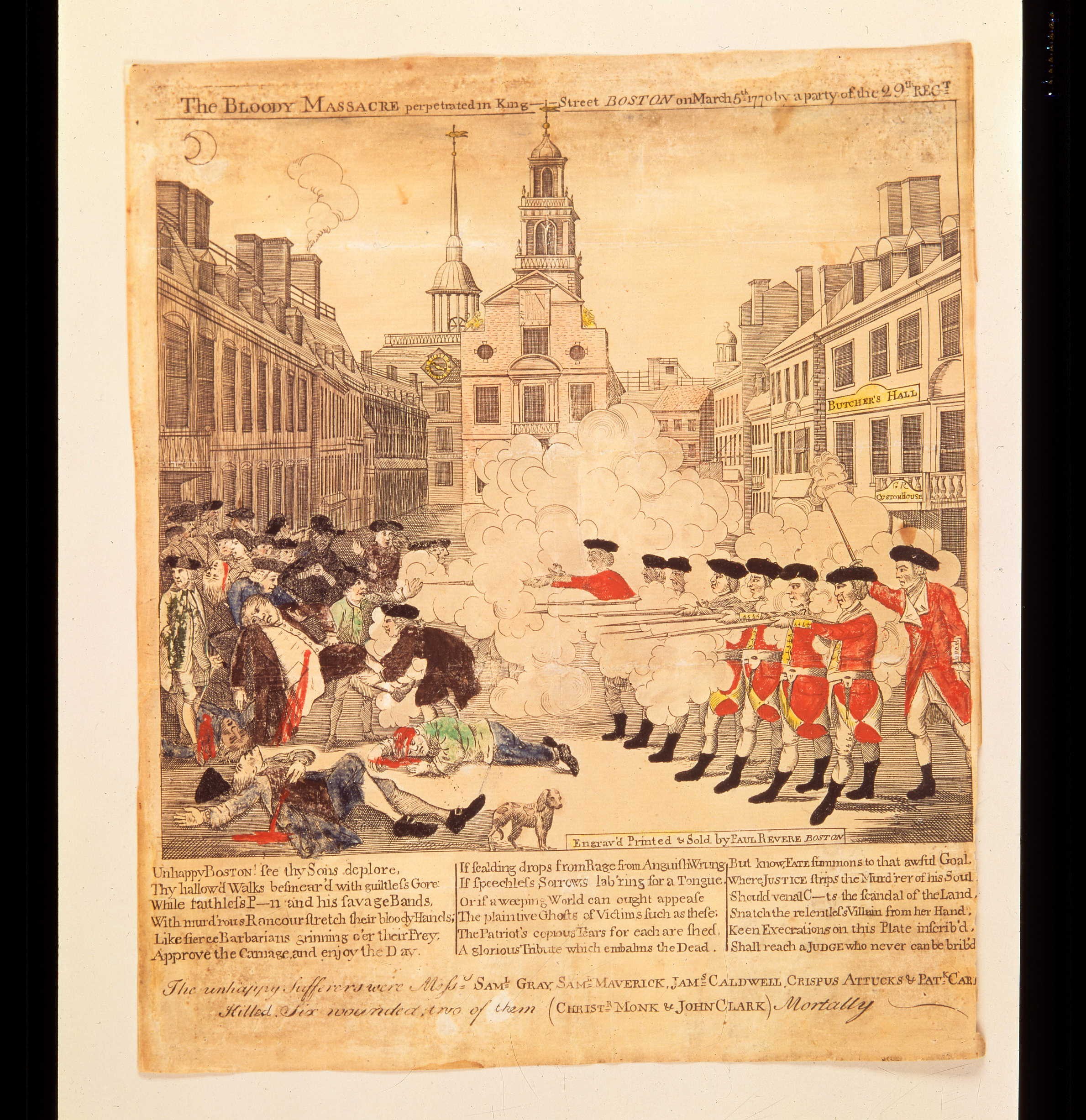
Paul Revere's depiction of the Boston Massacre:
http://ww1.prweb.com/prfiles/2007/03/20/513012/BloodyMassacre.jpg
Paul Revere's complete account of the ride:
http://www.americanrevolution.org/revere.html
So, Paul Revere was a member of two secret societies that wanted to change the government of the colonies. When they wanted to meet, or exchange information, they could not just call each other up on the phone, this was the 1770's (the fist phone conversation wouldn't take place for 100 years! - March 10th, 1876). They had to send letters that were carried by messengers like Paul Revere. Let's read about the message that Paul Revere carried to warn Samuel Adams and John Hancock that British soldiers were coming to arrest them.
The most famous version of Paul Revere's ride was recorded in Henry Wadsworth Longfellow's poem "The Midnight Ride of Paul Revere." But, Paul Revere's diary tells a different story than the famous poem. As we read the poem together, please fill in the details on your worksheet. Then we will read Paul Revere's diary, and compare and contrast the two.
Longfellow's Poem
http://www.kidsandhistory.com/paulvm/h1_midride/ridepages_nosound/ridefset.html
The Real Ride:
http://www.kidsandhistory.com/paulvm/h2_real.html
Paul Revere's depiction of the Boston Massacre:
http://ww1.prweb.com/prfiles/2007/03/20/513012/BloodyMassacre.jpg
Paul Revere's complete account of the ride:
http://www.americanrevolution.org/revere.html
Tuesday, February 10, 2009
2/10/09 - 5th Grade - SPACE!
You guys asked a lot of great questions about outer space. I did some research, and found web sites that will hopefully give you some answers.
Space has fascinated humans since the beginning of recorded history! The origins of astronomy (the scientific study of celestial objects) date back to ancient Mesopotamia (5000 to 5500 years ago!). Many of the questions that you have asked are still unanswered. If you are interested in Space, consider studying Physics in High School and College. Here are some of your questions, and some of the answers I have come up with.
How long does it take (the space shuttle) to orbit the earth?
http://www.nasa.gov/missions/highlights/webcasts/shuttle/sts113/processing-qa_prt.htm
How big is space?
http://www.pbs.org/wgbh/nova/universe/howbig.html
Why can't we breathe in outer space?
http://en.wikipedia.org/wiki/Outer_space
Why is there zero gravity in space?
http://www.nasm.si.edu/exhibitions/gal109/NEWHTF/HTF611.HTM
http://library.thinkquest.org/TQ0312074/zg.htm
How long does it take to get to outer space?
How long can a star stay alive?
http://www.farmersalmanac.com/astronomy/a/how_long_does_a_star_last_in_outer_space
How long can we stay in space?
http://query.nytimes.com/gst/fullpage.html?res=9B0DE1DD1630F93AA15751C1A961948260
Do they eat special food in space?
http://spaceflight.nasa.gov/living/spacefood/index.html
How far away is the moon?
http://coolcosmos.ipac.caltech.edu/cosmic_kids/AskKids/moondist.shtml
How do asteroids form?
http://curious.astro.cornell.edu/question.php?number=221
How are black holes formed?
http://hubblesite.org/explore_astronomy/black_holes/
http://cosmology.berkeley.edu/Education/BHfaq.html
Keep asking good questions, and seeking truthful answers!
Space has fascinated humans since the beginning of recorded history! The origins of astronomy (the scientific study of celestial objects) date back to ancient Mesopotamia (5000 to 5500 years ago!). Many of the questions that you have asked are still unanswered. If you are interested in Space, consider studying Physics in High School and College. Here are some of your questions, and some of the answers I have come up with.
How long does it take (the space shuttle) to orbit the earth?
http://www.nasa.gov/missions/highlights/webcasts/shuttle/sts113/processing-qa_prt.htm
How big is space?
http://www.pbs.org/wgbh/nova/universe/howbig.html
Why can't we breathe in outer space?
http://en.wikipedia.org/wiki/Outer_space
Why is there zero gravity in space?
http://www.nasm.si.edu/exhibitions/gal109/NEWHTF/HTF611.HTM
http://library.thinkquest.org/TQ0312074/zg.htm
How long does it take to get to outer space?
How long can a star stay alive?
http://www.farmersalmanac.com/astronomy/a/how_long_does_a_star_last_in_outer_space
How long can we stay in space?
http://query.nytimes.com/gst/fullpage.html?res=9B0DE1DD1630F93AA15751C1A961948260
Do they eat special food in space?
http://spaceflight.nasa.gov/living/spacefood/index.html
How far away is the moon?
http://coolcosmos.ipac.caltech.edu/cosmic_kids/AskKids/moondist.shtml
How do asteroids form?
http://curious.astro.cornell.edu/question.php?number=221
How are black holes formed?
http://hubblesite.org/explore_astronomy/black_holes/
http://cosmology.berkeley.edu/Education/BHfaq.html
Keep asking good questions, and seeking truthful answers!
Thursday, October 23, 2008
10/23/08 5th grade Tsunamis / Body Systems Quiz

Ms. Gonzalez's 5th grade class was reading about Tsunamis in their science book, so she asked me to present information about how they happen. We explored an interactive website from NOVA that showed a time line and diagram of the December 26, 2004 Tsunami in the Indian ocean. The site showed where and how the tsunami started (it's epicenter), what the effect was in the open ocean, and what happened when the tsunami made landfall. We watched a short national geographic video clip with video of the tsunami making landfall, and a computer simulation of how the tsunami progressed. We looked at satellite photos of the coast of Thailand before and after the Tsunami. We reviewed what we had learned about tsunamis with a Wikipedia article. To reinforce a previous lesson on the circulatory and respiratory systems, and preview the other body systems they would be learning about, the students took a quia quiz on body systems. Their percentage of correct answers had improved from when they learned about the systems and took the quiz, two weeks earlier.
NOVA Tsunami Interactive:
http://www.pbs.org/wgbh/nova/tsunami/anatomy.html
National Geographic Tsunami Video:
http://www.youtube.com/watch?v=j9JDzBTwiig
Singapore Satellite photos:
http://www.crisp.nus.edu.sg/tsunami/Khao_Lak_20041229_20030113/Khao_Lak_20041229_20030113.html
Tsunami wiki intro & characteristics:
http://en.wikipedia.org/wiki/Tsunami
Quia body systems quiz:
http://www.quia.com/rr/117725.html
Posted by Barrett Redelman at 8:57 AM 0 comments
Labels: 5th Grade, Media Cart, NOVA, Wikipedia, Youtube
Thursday, October 16, 2008
10/16/08 5th grade: Circulatory, Respiratory, Skeletal Systems
Today, Ms. Gonzalez's 5th grade class learned more about three body systems that were introduced in their science class. We used a bellevue public schools website about the body to transition from cells (which they learned about a few weeks prior), to body systems. Students built on what we had learned about cells to talk about groups of cells that worked together (tissues), and bigger groups of cells that worked together to perform a function (organs), and organs that worked together to perform several related functions (body systems). We covered three systems ( the circulatory system, respiratory system, and skeletal system), today, and the website presented a thorough overview in accessible and grade appropriate language. To review what the students had learned about the systems, they took a quiz as a class. We passed the wireless mouse around the classroom, and table groups discussed the question at hand before clicking their response. Students appeared to enjoy the quizzes which were in the style of 'who wants to be a millionaire?'.
Circulatory System:
http://www1.bellevuepublicschools.org/curriculum/k6web/fifthgrade/bodysys/Circulatorysystem.html
Respiratory System:
http://www1.bellevuepublicschools.org/curriculum/k6web/fifthgrade/bodysys/Respiratorysystem.html
Skeletal System:
http://www1.bellevuepublicschools.org/curriculum/k6web/fifthgrade/bodysys/Skeletalsystem.html
Quia Quizzes:
http://www.quia.com/rr/117725.html
http://www.quia.com/rr/269891.html
Circulatory System:
http://www1.bellevuepublicschools.org/curriculum/k6web/fifthgrade/bodysys/Circulatorysystem.html
Respiratory System:
http://www1.bellevuepublicschools.org/curriculum/k6web/fifthgrade/bodysys/Respiratorysystem.html
Skeletal System:
http://www1.bellevuepublicschools.org/curriculum/k6web/fifthgrade/bodysys/Skeletalsystem.html
Quia Quizzes:
http://www.quia.com/rr/117725.html
http://www.quia.com/rr/269891.html
Thursday, October 9, 2008
10/9/08 5th Grade: The Great Depression

Today, Ms. Gonzalez brought the 5th grade down to the St. Julie Learning center, to learn about the great depression. We began with a brief overview of the optimism of the 1920s, and the circumstances that led to stock market speculation. We talked about how stock markets work, and how buying on credit led Americans to end up owing much more then what they had. After discussing briefly the stock market crash and its effect on the economy, we began a 1930s webquest created by students in the Indiana University School of Education. We gave each member of the class a role in the 1930s job market, and discussed how one in four of them would realistically be unemployed. After students were given their job, they used links from the great depression webquest site to research the income of such a worker. With income in hand, they saw the average cost of goods such as winter coats, the types of food they would eat, beds, and appliances. The cost of these goods, relative to their income was surprising. We ran a little short on time, but Ms. Gonzalez expressed interest in following up with her class next week.
Resources:
The Great Depression PowerPoint Presentation: http://webzoom.freewebs.com/centralhistory/A%20C%2014%20US%20CHAPTER%2014.ppt
Webquest:The Great Depression: http://education.iupui.edu/webquests/depression/webquest.htm
1932 Consumer Goods Price List: http://www.todaysteacher.com/TheGreatDepressionWebQuest/1932PriceList.htm
Thursday, September 25, 2008
9/25/08 - 5th Grade Cell Structure
Today we spent our 45 minutes looking at the structure of plant and animal cells, using great website and PowerPoint resources found by Ms. Briceño. The PowerPoint (slightly modified) provided a thorough introduction to cells, their parts, and the difference between plant and animal cells. We watched a youtube video of an amoeba, when we got to the point in the presentation about prokaryotes. We ended with a test on quia.com over organelles (the parts of a cell), and passed the wireless mouse around the classroom to give different tables a chance to answer. The game was called rags to riches, and was similar to Who Wants To Be A Millionaire. After two tries, the class nearly made it to the top.
Cell Powerpoint: http://www.science-class.net/PowerPoints/Cell_structure_function.ppt
Cell Structure Rags To Riches Game: http://www.quia.com/rr/354661.html
Another Cell Structure Rags to Riches Gamehttp://www.quia.com/rr/107541.html
Amoeba Video: http://uk.youtube.com/watch?v=zTFsn9xt7b0&feature=related
Flagella and Cilia video:http://www.youtube.com/watch?v=QGAm6hMysTA&feature=related
Cell Powerpoint: http://www.science-class.net/PowerPoints/Cell_structure_function.ppt
Cell Structure Rags To Riches Game: http://www.quia.com/rr/354661.html
Another Cell Structure Rags to Riches Gamehttp://www.quia.com/rr/107541.html
Amoeba Video: http://uk.youtube.com/watch?v=zTFsn9xt7b0&feature=related
Flagella and Cilia video:http://www.youtube.com/watch?v=QGAm6hMysTA&feature=related
Subscribe to:
Posts (Atom)